

Driving in Puerto Rico: What Visitors Need to Know Before Getting Behind the Wheel

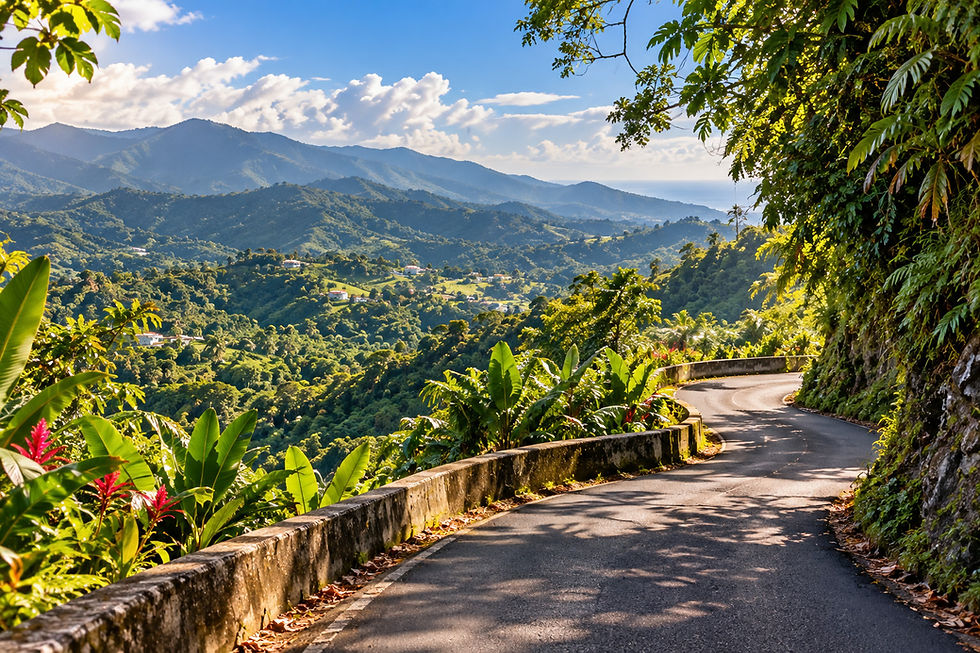
Renting a car is one of the best ways to experience Puerto Rico.
Beyond San Juan, a car gives you the freedom to discover mountain towns, roadside restaurants, hidden beaches, coffee farms, waterfalls, and communities that many visitors never see.
Driving here will also introduce you to a few things you probably weren’t expecting.
Puerto Rico drives on the right side of the road, traffic laws are generally familiar to U.S. drivers, and a valid U.S. driver’s license can be used on the island. But local roads, parking, driving habits, and a few unusual traffic rules can make your first drive an adventure.
Here’s what you should know before you grab the keys.
Yes, You Can Go Through a Red Light at Night—But There’s a Rule
This is probably Puerto Rico’s most surprising traffic rule for visitors.
Between midnight and 5:00 a.m., drivers approaching a red traffic light must stop, but may then proceed through the intersection after making sure it is safe to do so.
Think of the red light somewhat like a stop sign during those hours: stop first, check carefully for pedestrians and traffic, and proceed only when it is safe.
This isn’t simply an informal local custom. It’s included in Puerto Rico’s traffic rules. Puerto Rico’s official CESCO review of Law 22 states that vehicles encountering a red light between 12:00 a.m. and 5:00 a.m. may continue after stopping and taking the necessary precautions.
During normal hours, however, a red light means exactly what you expect it to mean.
And don’t confuse the rule with permission to simply drive through a red light. You still have to stop first.
Miles, Not Kilometers
Here’s another quirk.
Puerto Rico is a U.S. territory, but you’ll encounter a curious mixture of measurement systems.
Speed limits are posted in miles per hour, just like in the continental United States.
Official guidance lists general maximum speeds of 25 mph in urban areas, 45 mph in rural areas, and up to 65 mph on expressways, although posted limits always take precedence.
But road distances are often given in kilometers, and locations along highways are frequently identified using kilometer markers.
So you may be driving 45 miles per hour toward an address at Kilómetro 18.5.
Welcome to Puerto Rico.
GPS Is Your Friend—But Don’t Follow It Blindly
Google Maps, Apple Maps, and Waze generally work well in Puerto Rico, and GPS is especially helpful because traditional street addresses can sometimes be confusing. Discover Puerto Rico also recommends navigation apps for traveling around the island.
But there’s an important rule:
Use GPS as a guide, not a command.
This becomes particularly important in the mountains.
An app may decide that a tiny local road saves four minutes. What it doesn’t always communicate very well is that your “shortcut” might be an extremely narrow road winding along the side of a mountain.
If a route suddenly looks dramatically smaller than the road you’re currently traveling on, consider staying on the larger numbered route even if GPS says the alternative is slightly faster.
And if you’re heading somewhere remote, download your route before leaving. Cellular service can become inconsistent in mountainous areas. Discover Puerto Rico similarly recommends having backup directions when traveling into remote parts of the island.
Mountain Roads Are a Different Kind of Driving
Some of Puerto Rico’s most beautiful destinations are in the Cordillera Central and other mountainous areas.
Getting there can be half the experience.
Expect:
Narrow roads. Sharp curves. Steep hills. Blind corners. Limited shoulders. And spectacular views.
A destination that looks relatively close on a map can take much longer to reach than expected. Puerto Rico’s official tourism site specifically cautions travelers that roads through the central mountains are winding and travel times can be longer than the distance suggests.
The key is simple:
Slow down.
Don’t worry if a local driver catches up behind you. Someone who drives the same mountain road every day will naturally be more comfortable on it than someone seeing it for the first time.
When there’s a safe place to pull over, let them pass.
Then continue at a speed that feels comfortable.
Use Your Horn on Blind Mountain Curves
In rural areas, you may occasionally hear a quick horn before a vehicle rounds a particularly narrow or blind curve.
It isn’t necessarily someone being impatient.
It’s often a practical warning:
“I’m coming around the corner.”
On extremely narrow roads where two vehicles may have difficulty passing, a brief horn can alert an approaching driver who can’t see you.
Listen for other drivers doing the same.
Don’t Be Afraid of the Narrow Roads
Your first reaction to some Puerto Rican mountain roads may be:
“There is absolutely no way two cars fit here.”
Somehow, they usually do.
Slow down considerably when another vehicle approaches. Move carefully toward your side without dropping a wheel off the pavement. One vehicle may stop while the other passes.
You may even need to fold in a mirror occasionally on exceptionally tight streets or rural roads.
Take your time.
Puerto Rican drivers who live in these areas are accustomed to sharing narrow roads.
Avoid Mountain Driving at Night When Possible
If you’re unfamiliar with an area, try to reach remote mountain destinations before dark.
Street lighting may be limited or nonexistent, curves can be difficult to anticipate, and heavy rain or fog can reduce visibility dramatically.
That beautiful scenic road you enjoyed during the afternoon can feel very different at 10:00 p.m.
For your first trip into Puerto Rico’s interior, daylight is your friend.
Rain Changes Everything
Tropical rain can arrive quickly.
A sunny afternoon can become a downpour within minutes, particularly around the mountains and rainforest.
Puerto Rico’s driver’s manual specifically warns that rain, moisture, leaves, gravel, and other material can make roads slippery.
During heavy rain, reduce your speed and increase your following distance.
Water can collect quickly on roads, and visibility may drop dramatically.
If conditions become uncomfortable, find a safe place completely off the roadway and wait. Tropical showers can be intense but sometimes pass surprisingly quickly.
Parking May Be the Hardest Part of Your Trip
Driving around Puerto Rico is often easier than finding somewhere to put the car once you arrive.
This is particularly true in Old San Juan, Condado, Santurce, and other densely developed areas.
Street parking can be limited, something Puerto Rico’s tourism authority also warns visitors about.
When visiting Old San Juan, a parking garage is often worth the expense. Instead of circling narrow streets searching for the perfect free space, park and explore on foot.
In Condado and other busy neighborhoods, check whether your restaurant or destination offers valet parking or whether a public garage is nearby.
Sometimes paying for parking saves 30 minutes of frustration.
Be Careful Where You Street Park
Don’t assume that an empty space automatically means you can park there.
Watch for:
No Parking (No Estacione) signs, driveways, loading areas, curbs, pedestrian crossings, reserved spaces, and entrances that need to remain accessible.
Puerto Rico’s official driver’s guidance requires vehicles to be parked on the right and within 12 inches of the curb or edge of the roadway and prohibits parking in locations such as pedestrian crossings.
Also pay attention to how your car affects traffic.
A road that looks reasonably wide when empty can become extremely tight when cars are parked on both sides.
When in doubt, use a legitimate parking lot or garage.
Old San Juan Requires Extra Patience
Driving through Old San Juan deserves its own warning.
The streets were laid out centuries before automobiles existed.
Expect narrow streets, one-way roads, pedestrians, delivery trucks, tour vehicles, cobblestones, and very limited street parking.
The easiest strategy is often:
Drive in. Park. Walk.
Old San Juan is compact and best experienced on foot anyway.
Wear comfortable shoes and enjoy it.
San Juan Traffic Is Real
Puerto Rico may be an island, but San Juan is a major metropolitan area.
Rush hour can be busy.
Discover Puerto Rico specifically suggests avoiding approximately 8:00–10:00 a.m. and 4:00–6:00 p.m. when possible.
Allow extra time if you’re heading to the airport, a ferry, a dinner reservation, or an excursion with a fixed departure time.
A 15-minute drive at midday may not be a 15-minute drive during rush hour.
You’ll Encounter Tolls
Puerto Rico has several toll highways, and many toll facilities operate electronically.
Rental vehicles commonly use AutoExpreso, Puerto Rico’s electronic toll system. Discover Puerto Rico notes that many rental cars include the AutoExpreso transponder because most tolls have transitioned away from cash collection.
Ask your rental company how toll charges are handled.
Some companies charge the toll plus an administrative fee, while others offer toll packages.
Understanding the policy before leaving the rental counter can prevent an unpleasant surprise on your final bill.
Put the Phone Down
Using a handheld phone while driving can violate Puerto Rico traffic law.
Puerto Rico’s Traffic Safety Commission states that reading or sending text messages, emails, or performing other activities that take your attention from the road is prohibited. Hands-free calls are permitted.
Set your GPS before moving or have a passenger handle navigation.
That’s especially important on unfamiliar mountain roads, where you need your full attention on the road ahead.
Puerto Rican Driving Has Its Own Rhythm
Spend enough time driving around the island and you’ll start noticing the local rhythm.
Drivers may be more assertive about merging than you’re accustomed to. Turn signals aren’t always as predictable as you’d like. Traffic can suddenly slow. Roads can transition surprisingly quickly from modern expressways to narrow neighborhood streets.
The best response isn’t to imitate aggressive driving.
Stay alert, be predictable, leave space, and don’t rush.
If someone wants to pass you, let them.
Your vacation isn’t improved by winning a competition with another driver.
Don’t Judge Distance by the Map
This is particularly important when planning day trips.
Twenty miles on a major highway and twenty miles through the mountains are two completely different journeys.
A mountain restaurant may appear relatively close to your vacation rental but require an hour of winding roads to reach.
Build extra time into your plans.
Better yet, consider the drive part of the experience.
Stop at the roadside bakery.
Pull over at the scenic overlook.
Try the little lechonera you weren’t planning to visit.
Puerto Rico often rewards travelers who aren’t in a hurry.
Driving Is One of the Best Ways to Understand Puerto Rico
If you only experience the metropolitan area and major tourist attractions, you’re seeing just one part of the island.
Drive into the mountains and the landscape changes.
Highways become winding roads. High-rise buildings give way to brightly colored concrete homes tucked into hillsides. You’ll pass plantain fields, roadside fruit stands, neighborhood bakeries, small plazas, coffee farms, and restaurants where the day’s menu may be written on a board outside.
You’ll begin to understand why people identify so strongly with their hometowns and regions.
And you’ll discover that Puerto Rico isn’t simply a collection of attractions.
It’s hundreds of communities connected by roads.
Some of those roads are wide and modern.
Others may make you grip the steering wheel a little tighter.
Take your time. Pay attention. Leave some room in your schedule for getting lost.
Because sometimes the road you weren’t planning to take becomes one of the best parts of experiencing Puerto Rico.


Comments